Your domain name is your permanent address on the internet. Change it later, and you lose SEO value, break existing links, confuse customers, and update every piece of marketing material you've ever created.
Getting it right the first time matters.
But "right" isn't a single answer. The perfect domain balances brandability, memorability, availability, relevance, and sometimes budget constraints. Let's work through how to find a domain that serves your business well.
What Makes a Good Domain Name
Before diving into tactics, understand what you're optimizing for:
Memorable. People should remember it after hearing it once. Domain names that stick in memory drive direct traffic and word-of-mouth.
Typeable. Users type domains into browsers. Every unusual spelling, hyphen, or number is a chance for typos that send traffic elsewhere.
Speakable. You'll say your domain name out loud—in meetings, on calls, in podcasts. If you have to spell it out every time, there's friction.
Brandable. Does it sound like a real company? Does it convey something about your identity or values?
Relevant. Connection to what you do helps users and can provide SEO benefits.
Available. Not just domain availability—social media handles, trademark conflicts, and similar considerations.
Starting Your Domain Search
Consider Your Brand Name First
If your business name is set, that's usually your domain. Consistency between business name and domain builds recognition and trust.
Company is "Apex Solutions":
- apexsolutions.com (ideal)
- getapexsolutions.com (if taken)
- apexsolutions.in (for India-focused business)
If your exact business name isn't available as a domain, you have a choice: modify the domain slightly, or reconsider the business name while you still can.
What If You're Still Naming the Business?
Domain availability can and should influence naming decisions. There's no point falling in love with a name whose .com is owned by a squatter asking ₹50 lakhs.
When brainstorming business names:
- Check domain availability simultaneously
- Search trademark databases
- Check social media handle availability
- Consider whether the name works internationally
It's easier to choose an available name than to fight for an unavailable one.
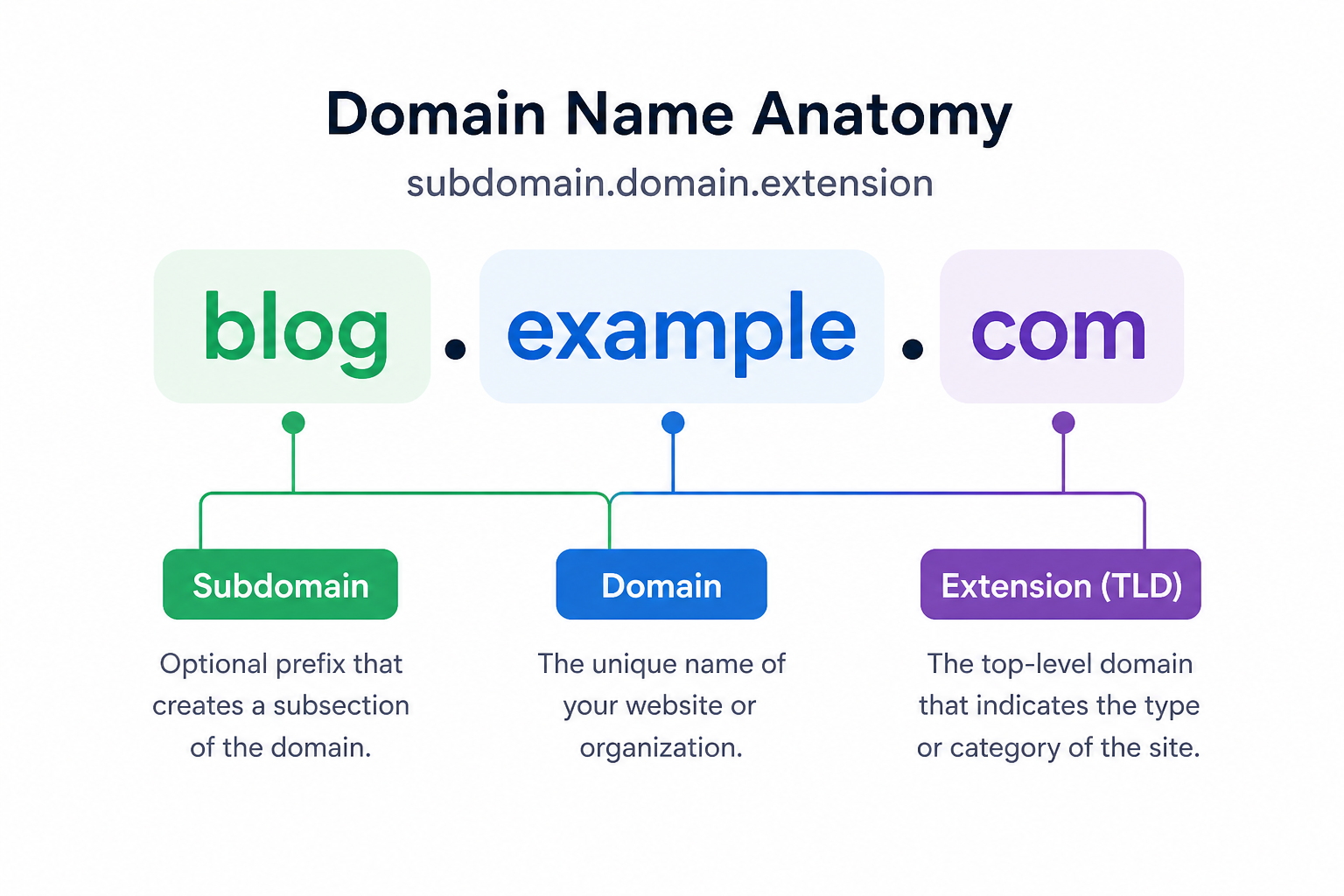
Domain Extension (TLD) Decisions
The extension matters more and less than you think.
.com Is Still King
If you can get the .com, get it. It's the default assumption. When someone tries to remember your domain, they'll probably try yourname.com first.
- Most credible for business
- Most universally recognized
- Least likely to cause confusion
The premium on .com domains exists because they work.
When to Use Country Extensions
.in for India-focused businesses:
If your business serves primarily Indian customers, .in is perfectly appropriate. It signals local presence and can help with local SEO.
Consider .in if:
- Your market is India
- You're a local business
- Indian identity is part of your brand
Avoid .in if:
- You plan to expand internationally
- Your audience expects .com
Newer Extensions (.io, .co, .tech, etc.)
Tech startups often use .io (originally British Indian Ocean Territory, now associated with input/output in tech culture). It's become acceptable in that industry.
.io: Tech companies, startups, developer tools
.co: Alternative to .com, some legitimacy built up
.tech: Technology companies
.store: E-commerce businesses
.app: Applications
These work when your audience is tech-savvy. For general consumer businesses, stick to .com or country extensions.
Extensions to Generally Avoid
- Extensions with negative associations (.xxx, certain country codes)
- Obscure extensions nobody recognizes
- Trendy extensions that might not age well
- Extensions requiring explanation to customers
What to Avoid in Domain Names
Hyphens
Bad: best-digital-marketing-solutions.com
Hyphens cause problems:
- Hard to communicate verbally
- Users forget them when typing
- Look spammy to many people
- Associated with lower-quality sites historically
Use hyphens only if absolutely necessary and you own the non-hyphenated version to redirect.
Numbers (Usually)
Unless numbers are part of your actual brand name (7-Eleven, 3M), avoid them:
- Confusion between numeral and spelled-out (7 vs seven)
- Hard to communicate clearly
- Often look less professional
Difficult Spellings
If you constantly have to spell it out ("that's 'ph' not 'f'"), consider alternatives. Unusual spellings might be creative, but they create friction.
- Double letters that might be single
- Letters that sound like other letters
- Non-obvious spellings of common words
Trademark Conflicts
Before registering, search trademark databases. Even if a domain is available, using a trademarked name can create legal problems.
Check:
- India Trademark Registry
- USPTO (if serving US market)
- EUIPO (for European Union)
- WIPO Global Brand Database
Unintended Meanings
Read your domain as one continuous string. Some famous examples of domains that didn't consider this:
- therapistfinder.com
- powergenitalia.com (Power Generation Italia)
- penisland.net (Pen Island)
Also consider international implications if you operate globally.
Practical Domain Selection Process
Step 1: Brainstorm Options
Generate 10-15 possibilities:
- Exact business name
- Abbreviations or acronyms
- Key product/service + modifier
- Action words + brand (get, try, use)
- Location-specific variations
Step 2: Check Availability
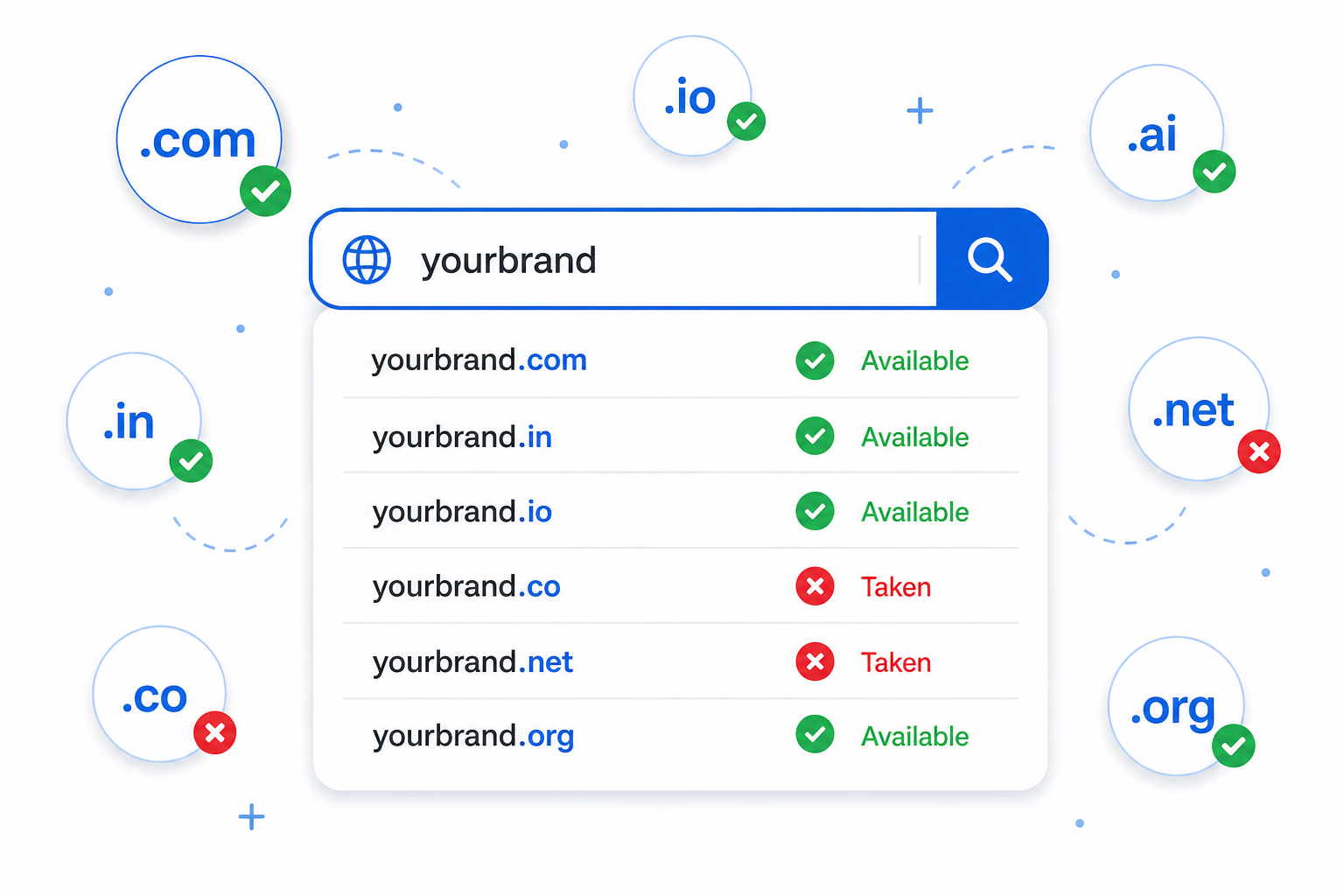
Use domain registrars (GoDaddy, Namecheap, Google Domains) to check availability. Also check:
- Social media handles on major platforms
- Trademark databases
- Web search (is anyone using this name?)
Step 3: Evaluate Top Candidates
For your best available options, evaluate:
| Criterion | Option A | Option B | Option C |
|---|---|---|---|
| Memorable | ★★★★★ | ★★★★☆ | ★★★☆☆ |
| Typeable | ★★★★★ | ★★★☆☆ | ★★★★☆ |
| Brandable | ★★★★☆ | ★★★★★ | ★★★☆☆ |
| Relevant | ★★★★★ | ★★★★☆ | ★★★★★ |
| Extension | .com | .in | .co |
Step 4: Test with Others
Say your top choices out loud to friends or colleagues:
- Can they spell it correctly?
- Do they remember it after a few minutes?
- What associations does it create?
- Any negative reactions?
Step 5: Secure Your Choice
Once decided:
- Register the domain immediately (names get sniped)
- Register common misspellings if affordable
- Consider registering other extensions to protect brand
- Set up auto-renewal to prevent accidental expiration
- Enable privacy protection to hide personal information
When the Perfect Domain Isn't Available
The .com you want is taken. What now?
Consider Alternatives
- Add a word: tryapex.com, apexhq.com, getapex.com
- Use location: apexindia.com, apexbangalore.com
- Use modifier: apexdigital.com, apexsoftware.com
- Different extension: apex.in, apex.io
Negotiate Purchase
Sometimes domains are for sale. Services like Sedo, Afternic, or direct outreach can facilitate purchases. Be prepared:
- Most good .coms have a price
- Prices range from hundreds to millions
- Negotiations can take time
- Not all owners will sell
When to Pay Premium
A premium domain might be worth it if:
- Your marketing budget is significant (domain cost becomes rounding error)
- The domain is short and highly memorable
- Exact match for a high-value keyword
- Your business model depends on direct traffic
For most small businesses, a well-chosen available domain beats an expensive "perfect" domain.
Domain SEO Considerations
Exact Match Domains (EMDs)
Domains like "cheapinsurance.com" once ranked well just because of keyword matching. This advantage has diminished significantly. Google devalued exact match domains to prevent manipulation.
Today, exact match domains provide minor benefit at best, and can look spammy. Brand-focused domains typically serve you better long-term.
Domain Age and History
Older domains sometimes have SEO advantages. But buying an old domain with spammy history can hurt more than help. Check Wayback Machine for any domain you're considering purchasing.
Domain Length
Shorter is generally better—easier to remember, type, and fit in limited spaces. But don't sacrifice clarity for brevity. "apex.com" is better than "apexsofts.com," but "apexsoftware.com" is better than "axs.com."
Securing and Managing Your Domain
Choose a Reputable Registrar
Where you register matters:
- Google Domains (now Squarespace Domains): Clean interface, reasonable pricing
- Namecheap: Good prices, solid service
- Cloudflare: At-cost pricing, advanced features
- GoDaddy: Largest, but watch for upsells
Avoid obscure registrars. If they go out of business, transferring domains can be painful.
Enable Protection Features
- Privacy protection: Hides your personal information from WHOIS lookups
- Domain lock: Prevents unauthorized transfers
- Two-factor authentication: Protects account access
- Auto-renewal: Prevents accidental expiration
Register for Multiple Years
Domain registration is cheap. Register for 3-5 years minimum:
- Prevents expiration accidents
- Minor positive SEO signal
- Price protection from increases
Final Thoughts
Your domain name will represent your business for years. It appears on business cards, emails, marketing materials, and in customers' memories.
Take time to choose well. Check availability across platforms. Say it out loud. Sleep on it. Then commit and move forward.
The perfect domain probably doesn't exist. A good, available domain that you register and build a great business on is better than endless searching for perfection.
Need help setting up your business website after choosing your domain? Duo Dev Technologies builds professional websites for businesses of all sizes. Contact us to get started.