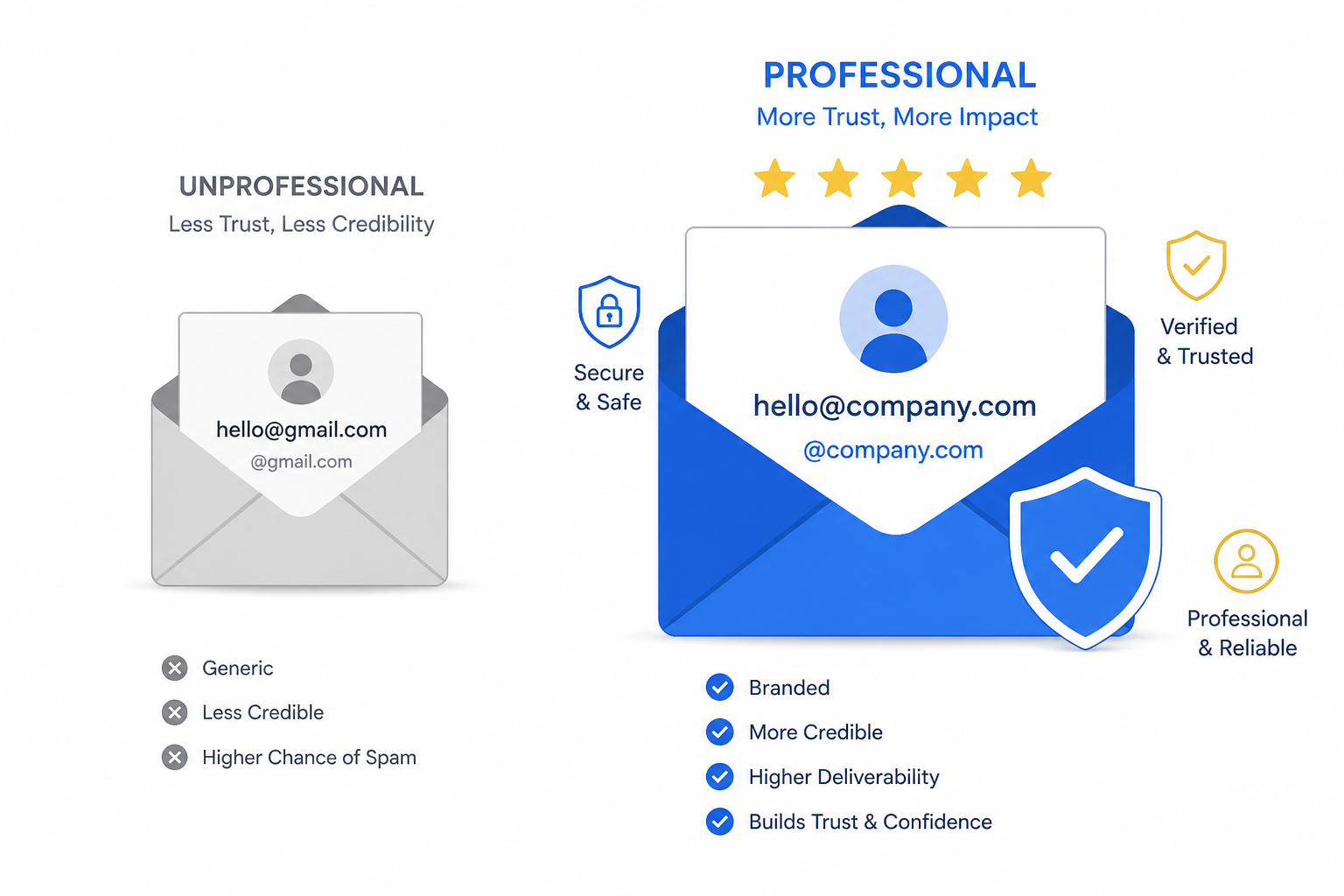
Quick question: Would you trust a lawyer using @gmail.com? How about a financial advisor with @yahoo.com?
Probably not.
That gut reaction—that instinctive skepticism—is exactly what your potential customers feel when they see a free email address on your business card.
Professional email addresses seem like a small detail. They're not. They shape first impressions, influence trust, and directly impact whether people do business with you.
Let's talk about why something as simple as your email domain matters.
The Psychology of First Impressions
Humans make snap judgments. Research shows we form impressions within milliseconds. These initial judgments are hard to reverse.
When someone sees your email address, they're unconsciously evaluating:
- Is this a real business or a hobby?
- Can I trust them with my money/data/project?
- Are they professional enough to deliver?
- How established is this company?
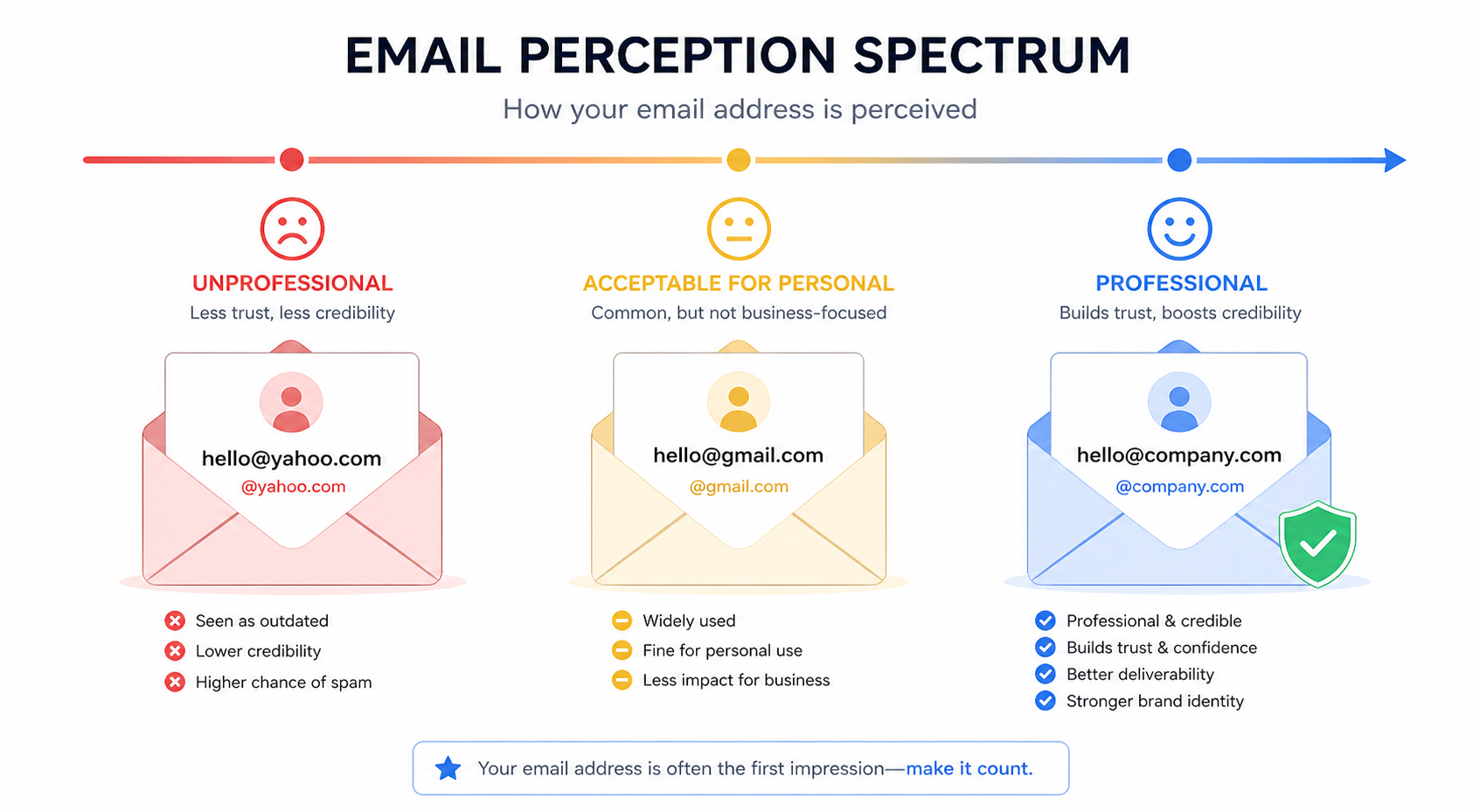
An email like info@yourcompany.com signals legitimacy. An email like yourcompany2024@gmail.com signals... something else.
Fair or not, people judge. And in business, perception shapes reality.
What Business Email Actually Communicates
Legitimacy
A custom domain email shows you've invested in your business. You own a domain. You've set up proper infrastructure. You're not a fly-by-night operation.
This matters especially for:
- Service businesses where trust is essential
- B2B companies reaching professional buyers
- E-commerce stores handling payment information
- Consultants and freelancers competing with agencies
Permanence
Free email providers come and go. Remember when everyone used @aol.com? Or @hotmail.com? Those addresses now feel dated.
A business email tied to your domain stays consistent. Even if you change email providers, your address remains the same. This signals stability and long-term thinking.
Investment
Setting up business email costs money (even if just a few dollars monthly). This small investment signals you're serious about your business.
It's like the difference between hand-printed business cards and professionally designed ones. Both convey information. One conveys care.
Real Impact on Business
Conversion Rates
Studies consistently show professional email addresses improve response rates. When you reach out to prospects, they're more likely to reply to john@yourcompany.com than john.smith.2024@gmail.com.
Why? Because they perceive less spam risk and more legitimacy. Professional addresses get through both mental filters and actual spam filters more reliably.
Email Deliverability
Free email providers like Gmail are heavily associated with spam. Many corporate email filters are more suspicious of messages from free domains.
Business email with proper DNS records (SPF, DKIM, DMARC) has better deliverability. Your important messages actually reach inboxes.
Customer Confidence
Think about payment confirmations, support responses, and invoice delivery. Customers feel more comfortable when these come from official-looking addresses.
receipt@yourstore.com feels trustworthy.yourstoreonline2023@gmail.com feels sketchy.
When money is involved, trust matters enormously.
Team Coordination
As your business grows, business email enables:
- Consistent team addressing (
sales@,support@,billing@) - Easier identification of team members
- Centralized management
- Simpler onboarding/offboarding
- Shared inboxes for departments
Trying to manage a growing team on personal email accounts is a headache you don't need.
The Hidden Benefits
Brand Consistency
Every email you send reinforces your brand. Recipients see your company name repeatedly. This builds recognition over time.
It's free advertising in every message. Your domain name appears in every interaction.
Professionalism in Signatures
Compare these email signatures:
John Smith
Owner
---
Contact: johnsmith2024@gmail.com
vs.
John Smith
Owner, Your Company
---
Email: john@yourcompany.com
Web: www.yourcompany.com
Phone: (555) 123-4567
Which owner would you rather work with?
Easier Marketing Compliance
Professional email makes complying with email marketing regulations easier:
- Clear sender identification
- Consistent from-addresses
- Proper authentication records
- Legitimate business identification
These matter for CAN-SPAM, GDPR, and other regulations.
Common Objections (Debunked)
"It's too expensive"
Business email costs $5-10 per user per month. For most businesses, that's less than a single coffee meeting. The trust and professionalism it conveys pays for itself many times over.
Even cheaper options exist: self-hosted email, smaller providers, or bundled hosting packages that include email.
"Gmail is free and reliable"
Gmail is excellent for personal use. But yourname@gmail.com tells clients you haven't invested in your business infrastructure.
You can actually use Gmail for business (Google Workspace) with your own domain. Same reliability, professional appearance.
"Nobody notices"
They do. Maybe not consciously, but that subconscious evaluation happens. And when competing with businesses that DO use professional email, you're at a disadvantage.
"I'm just starting out"
That's exactly when to establish professional habits. First impressions shape long-term perception. Starting professional is easier than rebranding later.
Setting Up Business Email
Getting started is easier than you think:
Option 1: Google Workspace
- Familiar Gmail interface
- $6-18 per user/month
- Excellent reliability and features
- Calendar, Drive, and Meet included
Option 2: Microsoft 365
- Outlook-based
- $6-22 per user/month
- Full Office suite included
- Great for businesses using Microsoft products
Option 3: Zoho Mail
- Budget-friendly option
- Free tier available (limited)
- Paid plans from $1/user/month
- Full-featured business email
Option 4: Self-Hosted
- Most affordable long-term
- Requires technical setup
- Full control over data
- Consider if you have IT resources
Essential Email Addresses to Create
At minimum, set up:
Primary addresses:
hello@orinfo@— General inquiriessupport@— Customer service[yourname]@— Personal business address
As you grow:
sales@— Sales inquiriesbilling@— Payment questionsteam@— Internal communicationscareers@— Job applications
Beyond Email: Building Digital Trust
Professional email is one piece of a larger trust puzzle. For comprehensive digital presence, also consider:
- Consistent branding across platforms
- Active social media presence
- Customer reviews and testimonials
- Secure payment processing
Each element reinforces the others. Professional email supports professional branding, which supports customer trust, which supports business growth.
The Bottom Line
Your email address is part of your brand. Every time you send a message, you're making an impression. Make it a professional one.
For less than the cost of a lunch meeting per month, you can present your business as established, legitimate, and trustworthy. That perception translates directly into customer confidence and, ultimately, revenue.
If you're still using @gmail.com or @yahoo.com for business, it's time to upgrade. Your customers—and your bottom line—will thank you.
Need help setting up professional email or building your digital presence? Contact Duo Dev to discuss your business needs.