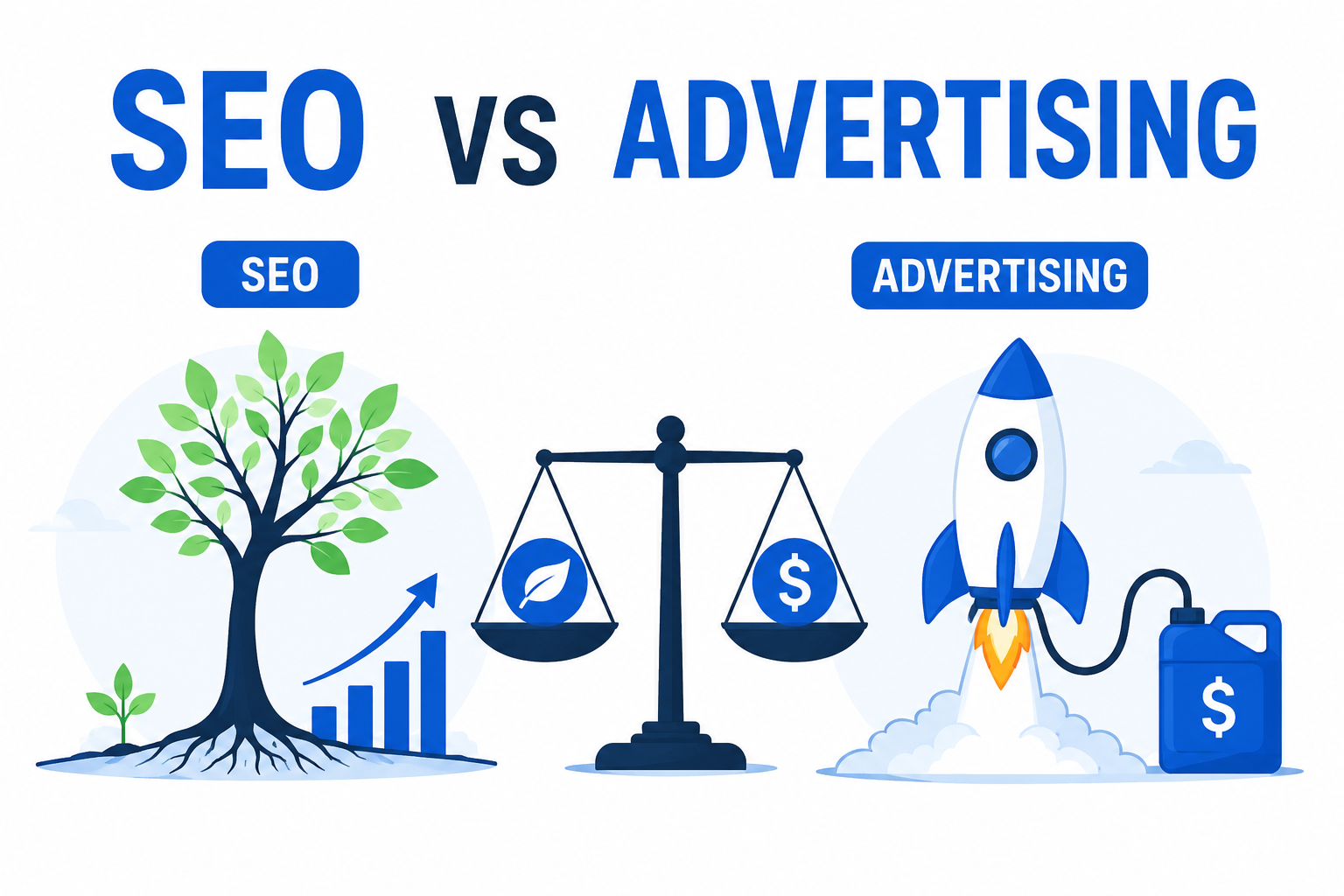
You have budget for marketing. Should you invest in SEO or paid advertising?
It's one of the most common business questions in digital marketing. And the answer isn't simple—because both work, but differently.
Let's break down the real differences so you can make the right choice for your situation.
Understanding the Basics
What SEO Delivers
SEO (Search Engine Optimization) improves your organic search visibility.
When someone searches "best project management software," SEO determines which websites appear in the unpaid results.
Good SEO means:
- Higher ranking for relevant searches
- More organic traffic
- Visibility without paying per click
Results take months but compound over time.
What Advertising Delivers
Paid advertising (Google Ads, social media ads) puts your message in front of people immediately.
You pay to appear:
- At the top of search results
- In social media feeds
- On other websites
Results are immediate but stop when spending stops.
The Core Differences
Speed of Results
Advertising: Start today, get traffic today.
Launch a campaign in the morning, have clicks by afternoon. The feedback loop is immediate.
SEO: Start today, see results in 3-6 months.
Consistent effort over time builds organic traffic. There's no shortcut to the timeline.
Winner: Advertising for speed, SEO for patience.
Cost Structure
Advertising: Pay per click/impression.
Each visitor has a direct cost. When you stop paying, traffic stops.
Monthly costs:
- Small business: $500-5,000/month
- Medium business: $5,000-50,000/month
- Enterprise: $50,000+/month
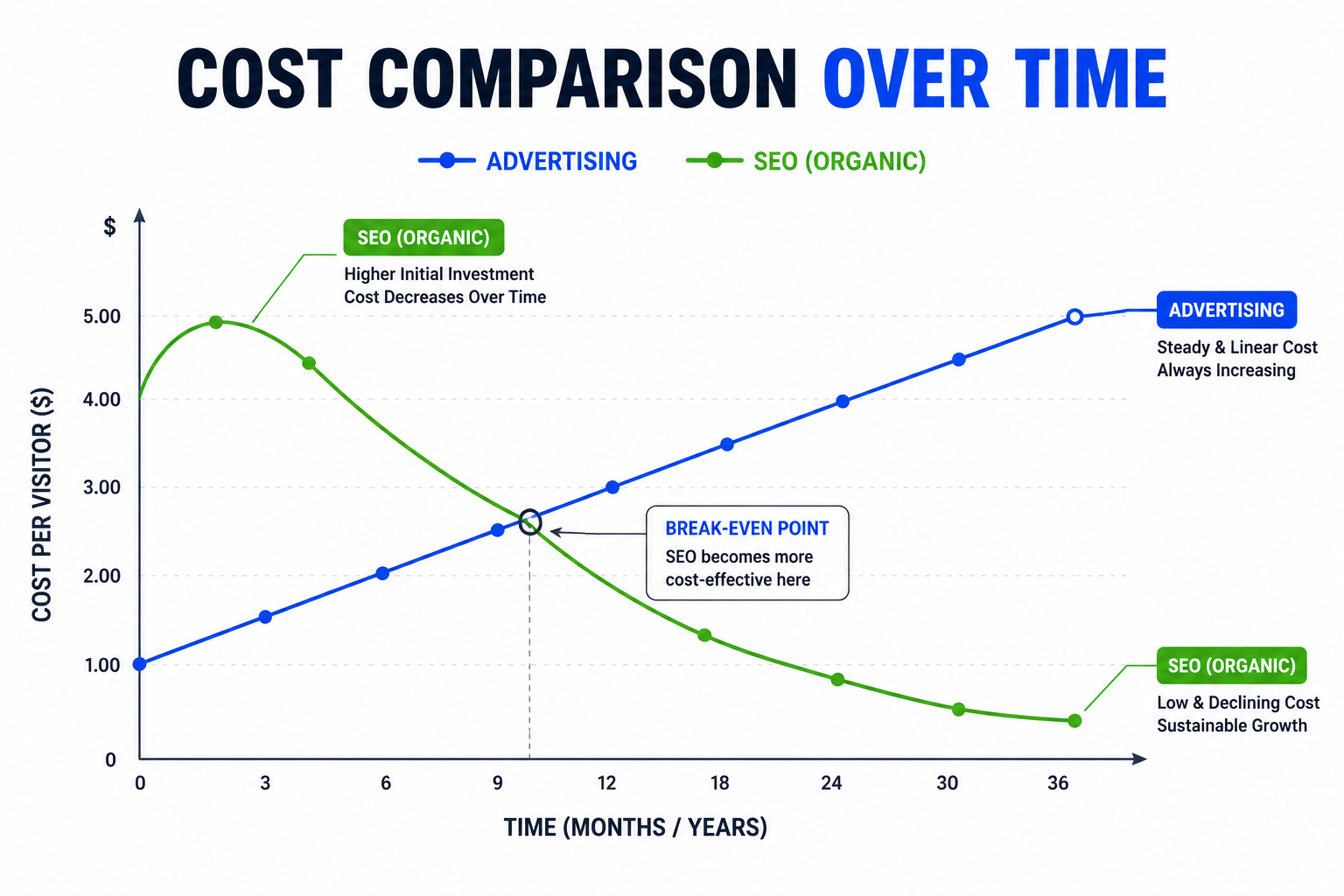
SEO: Investment with long-term returns.
Costs are primarily labor—content creation, technical optimization, link building.
Monthly costs:
- DIY: Time investment (10-20+ hours/month)
- Agency: $1,000-10,000/month
- Enterprise: $10,000+/month
But SEO traffic doesn't disappear when you stop paying the agency.
Winner: Depends on time horizon. Short-term: comparable. Long-term: SEO wins on cost-per-visitor.
Traffic Quality
Advertising: Varies by targeting.
Good targeting = relevant visitors. Poor targeting = wasted spend.
Requires constant optimization to maintain quality.
SEO: High intent traffic.
Organic searchers are actively looking for what you offer. They trust organic results more than ads.
Studies show organic results get 70-80% of clicks for most searches.
Winner: SEO generally has higher quality, but well-targeted ads can compete.
Scalability
Advertising: Linear scaling.
Want 2x traffic? Pay 2x more. The math is direct.
There's no compound effect—each visitor costs roughly the same.
SEO: Compound scaling.
Content builds on itself. Each new article, link, and optimization adds to existing assets.
A site with 100 ranking pages has a foundation. Adding 10 more pages is easier than the first 10.
Winner: SEO for compound growth.
Predictability
Advertising: Highly predictable.
You can forecast results based on budget. The numbers are controllable.
SEO: Less predictable.
Algorithm changes happen. Competitors improve. Results fluctuate.
You can estimate, but guarantees are impossible.
Winner: Advertising for predictability.
When to Choose Advertising
Product Launch
Launching something new? You need immediate visibility.
SEO takes months. A launch can't wait.
Ads get eyeballs fast, generate initial data, and create momentum.
Time-Sensitive Offers
Seasonal sale? Limited-time promotion? Event-based marketing?
Advertising reaches people now. SEO can't accelerate for short windows.
Testing Messaging
Not sure what resonates with your audience?
Ads let you A/B test messaging quickly:
- Which headlines work?
- What value propositions convert?
- Which audience segments respond?
This data informs everything else, including SEO.
Competitive Keywords
Some keywords are so competitive that ranking organically takes years.
"Insurance" and "loans" have billion-dollar companies investing in SEO.
Smaller players might need to pay for visibility on those terms.
Immediate Revenue Needs
Cash flow tight? Need customers now?
SEO is an investment—it pays later. Ads can generate revenue immediately.
When to Choose SEO
Long-Term Growth
Building something sustainable? SEO is the foundation.
Content you create today continues driving traffic for years.
A 5-year-old blog post can still rank and convert.
Limited Marketing Budget
Advertising requires ongoing spend. SEO requires upfront investment but delivers ongoing returns.
With limited budget, SEO often provides better long-term ROI.
Building Authority
Want to be seen as an industry expert?
Ranking organically signals credibility. People trust sites that rank without paying.
Sustainable Traffic
Advertising creates dependency. SEO creates assets.
If your ads stop, traffic stops. If your SEO stops, traffic gradually declines but doesn't vanish.
High Customer Lifetime Value
If each customer is worth thousands, investing months in SEO makes sense.
The long payoff period is justified by the long-term value.
The Real Answer: Both
Most successful businesses use both SEO and advertising.
Here's why:
They Complement Each Other
SEO takes time. Advertising fills the gap.
While building organic presence, ads maintain visibility and cash flow.
As SEO grows, ad dependence decreases.
Different Funnel Stages
Awareness: Display ads, social ads reach new audiences
Consideration: SEO content educates and nurtures
Decision: Remarketing ads bring back researchers
Retention: Email, content marketing maintain relationships
Each channel plays a role.
Data Sharing
Ad data informs SEO:
- Which keywords convert
- What messaging works
- Who your customers actually are
SEO insights improve ads:
- Search query data
- Content engagement metrics
- Audience behavior patterns
Risk Diversification
Relying on one channel is risky.
- Algorithm changes can tank SEO overnight
- Ad costs can spike unexpectedly
- Platform policy changes happen
Multiple channels spread risk.
A Balanced Approach
Phase 1: Launch (Months 1-6)
Advertising: 70-80% of budget
- Drive initial traffic
- Generate revenue
- Test and learn
SEO: 20-30% of budget
- Technical foundation
- Core content creation
- Local SEO basics
Phase 2: Growth (Months 6-18)
Advertising: 50-60% of budget
- Maintain visibility
- Scale what works
- Test new channels
SEO: 40-50% of budget
- Content production
- Link building
- Technical improvements
Phase 3: Maturity (18+ months)
SEO: 60-70% of budget
- Content dominates traffic
- Organic growth compounds
Advertising: 30-40% of budget
- Remarketing
- New product launches
- Competitive terms
The ratio shifts as organic traffic grows.
Measuring Success
Advertising Metrics
- Cost Per Click (CPC)
- Cost Per Acquisition (CPA)
- Return on Ad Spend (ROAS)
- Conversion Rate
SEO Metrics
- Organic traffic growth
- Keyword rankings
- Organic conversions
- Cost per organic visitor
Combined View
Track total Customer Acquisition Cost (CAC) across both channels.
A customer who clicks an ad, leaves, returns via organic search, and converts—which channel gets credit?
Use attribution modeling to understand the full journey.
Common Mistakes
Abandoning SEO for Quick Results
"SEO isn't working after 3 months, let's just do ads."
SEO rarely shows results in 3 months. Patience is required.
Relying Only on Paid
"Our ads work great, why bother with SEO?"
Ad costs tend to rise. Competition increases. Creating organic assets provides a safety net.
Not Tracking Properly
Without proper tracking, you can't know what's working.
Set up conversion tracking for both channels before spending.
Ignoring Quality
Paying for traffic to a bad website wastes money.
Investing in SEO for a broken site wastes time.
Making Your Decision
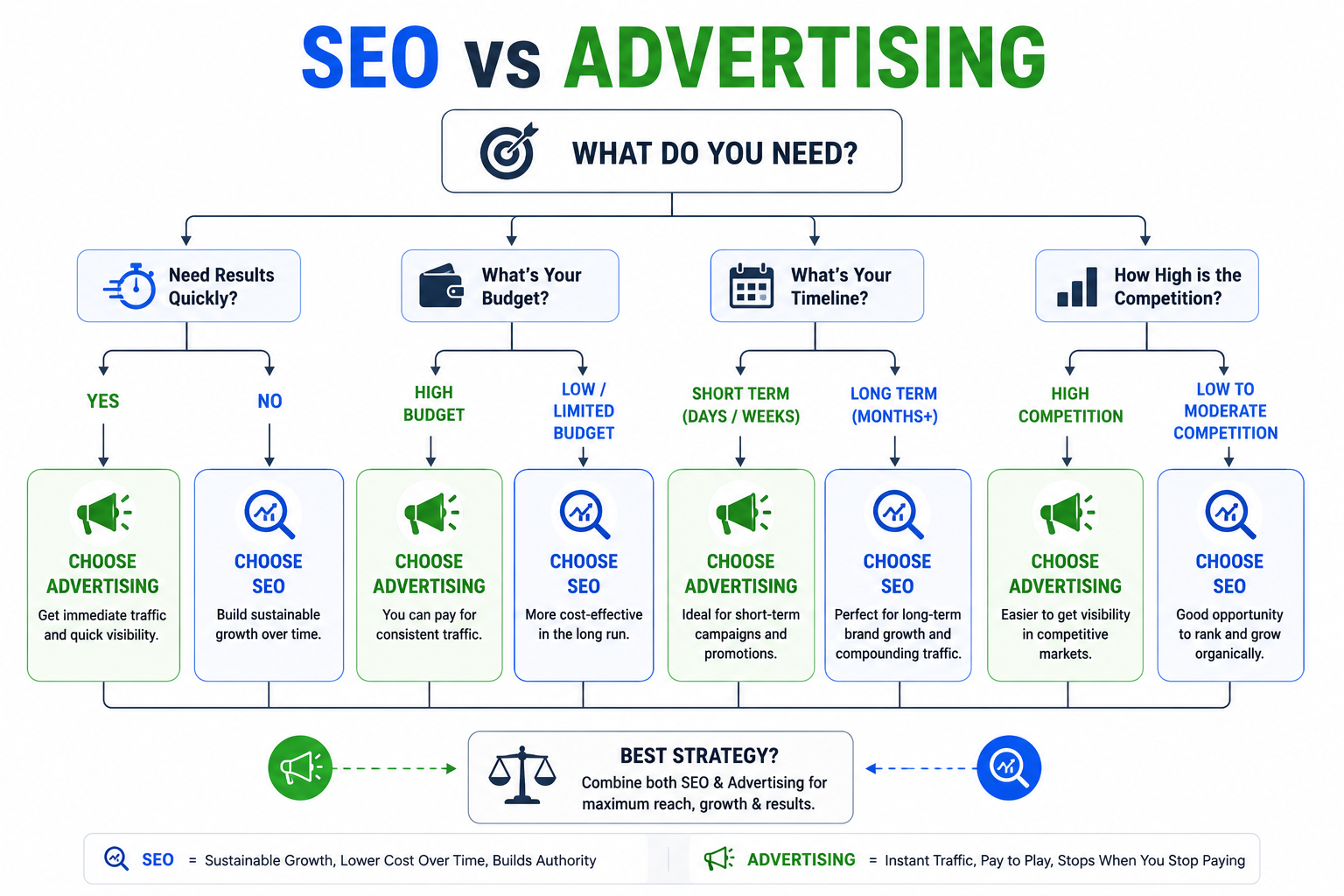
Ask yourself:
-
What's your timeline? Weeks = advertising. Months/years = SEO.
-
What's your budget structure? Monthly spend tolerance = advertising. One-time investment = SEO.
-
What's your competition? Highly competitive = consider advertising for quick wins.
-
What's your goal? Quick revenue = advertising. Long-term growth = SEO.
Most likely, the answer is both—in the right proportions for your stage.
Final Thoughts
SEO vs advertising isn't really a competition. They're different tools for different jobs.
Advertising is a faucet—turn it on, water flows. Turn it off, it stops.
SEO is a well—takes time to dig, but once it's flowing, it provides water for years.
Smart businesses dig the well while running the faucet.
Need help with digital marketing strategy, SEO, or website development? Contact Duo Dev to discuss the right approach for your business.