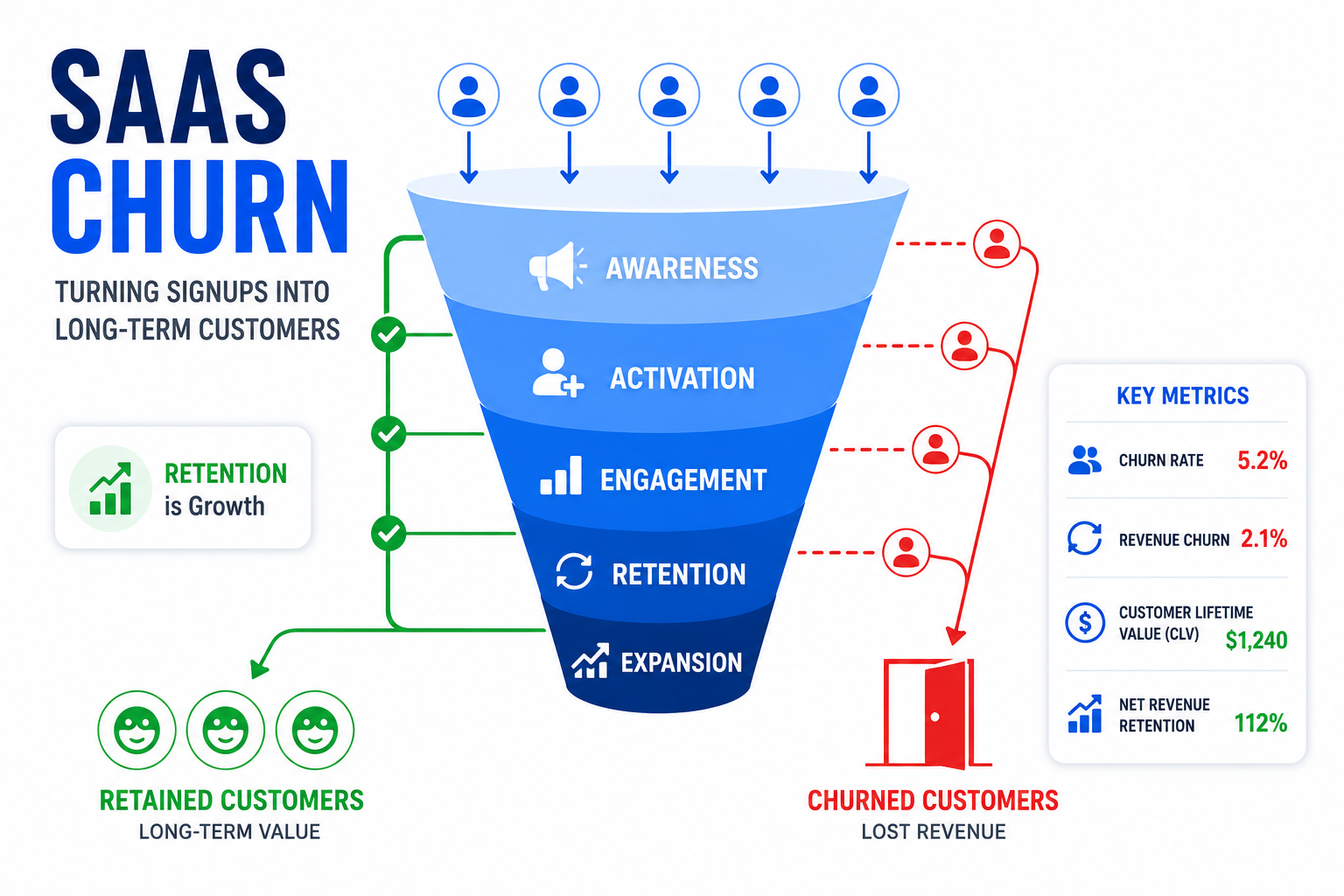
Acquiring a new customer costs 5-7x more than retaining an existing one. Yet many SaaS companies obsess over acquisition while their existing customers quietly slip away.
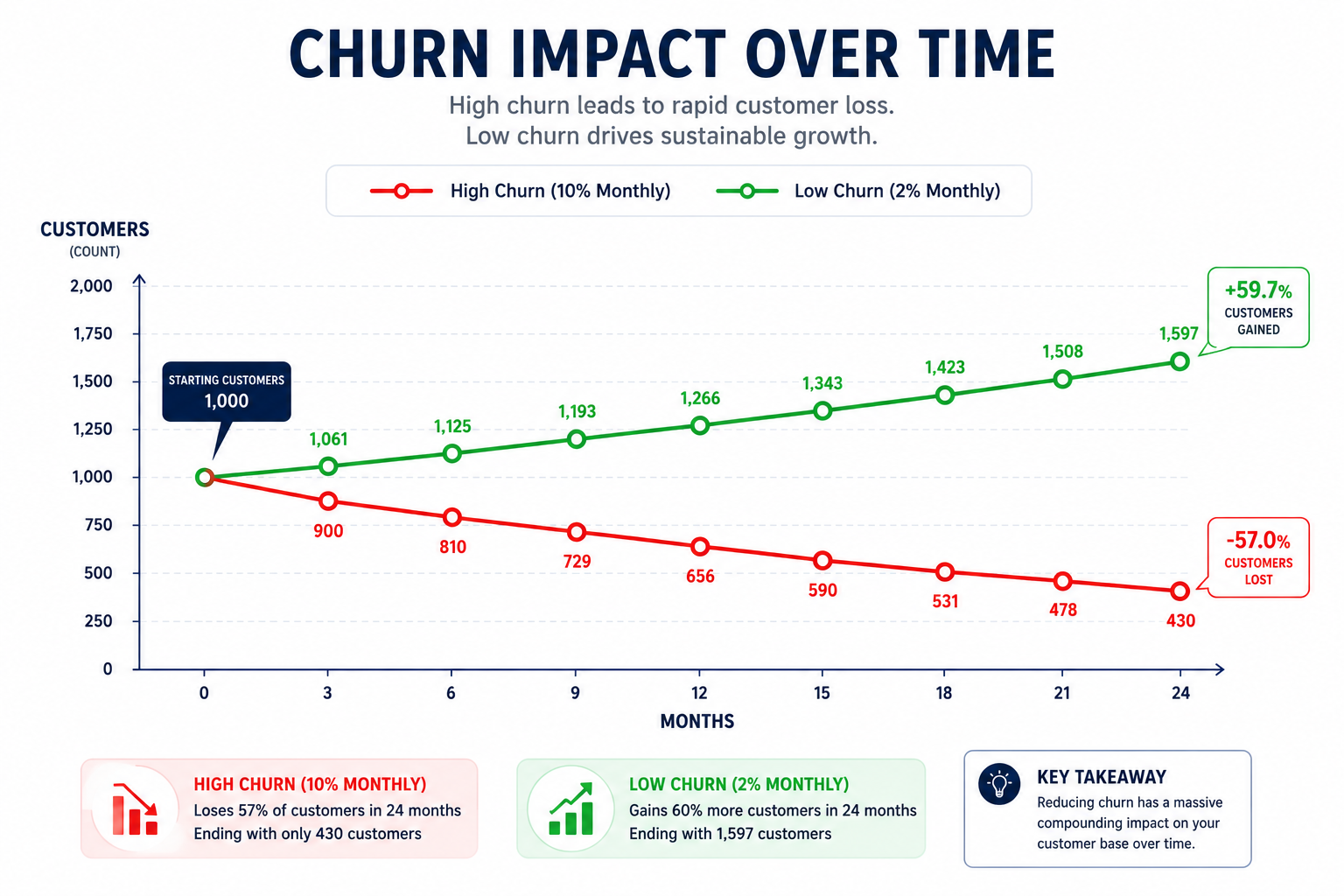
Churn is the silent killer of SaaS businesses. A 5% monthly churn rate means losing half your customers every year. That's not sustainable.
Let's talk about why customers leave and what you can do to keep them.
Understanding Churn
What Is Churn Rate?
Churn rate measures the percentage of customers who cancel their subscription during a given period.
Monthly churn rate = (Customers lost this month / Total customers at start of month) × 100
If you start with 1,000 customers and lose 50, your monthly churn rate is 5%.
Types of Churn
Voluntary churn: Customer actively cancels
- Found alternative solution
- No longer needs the product
- Dissatisfied with experience
- Budget constraints
Involuntary churn: Unintentional cancellation
- Failed payment
- Expired credit card
- Billing issues
Most companies focus on voluntary churn, but involuntary churn can account for 20-40% of total churn—and it's often easier to fix.
What's a Good Churn Rate?
Industry benchmarks vary:
| Business Type | Monthly Churn | Annual Churn |
|---|---|---|
| B2C SaaS | 3-7% | 30-60% |
| SMB B2B SaaS | 3-5% | 30-50% |
| Enterprise B2B SaaS | 1-2% | 10-20% |
Your goal: get as low as possible. Even small improvements compound significantly.
Why Customers Churn
Before fixing churn, understand its causes. Common reasons:
Product Problems
- Doesn't solve their problem: They signed up expecting X, but got Y
- Too complicated: Learning curve is too steep
- Missing features: Key functionality they need isn't available
- Bugs and unreliability: Product doesn't work when they need it
- Poor performance: Too slow, crashes, or downtime
Onboarding Failures
- No guidance: Left to figure things out alone
- Overwhelming start: Too much too fast
- No quick wins: Can't see value quickly
- Poor first experience: First impression is bad
Engagement Problems
- Forgot about it: Product became unused
- Habit not formed: Usage never became routine
- Low usage: Never fully adopted features
- No accountability: No one responsible for using it
Support Issues
- Slow response: Can't get help when needed
- Unresolved issues: Problems never fixed
- Poor communication: Feel ignored or unheard
External Factors
- Budget cuts: Company reducing expenses
- Business changes: Their needs changed
- Competition: Found a better/cheaper alternative
- Champion left: Person who advocated for product is gone
Identifying At-Risk Customers
Don't wait for cancellation. Spot warning signs early.
Usage Metrics
Track engagement signals:
- Login frequency declining
- Feature usage dropping
- Time in product decreasing
- API calls reducing (for technical products)
Set thresholds. If a customer who logged in daily now logs in weekly, that's a signal.
Engagement Scores
Create a health score combining:
- Product usage
- Support ticket sentiment
- Feature adoption
- Login frequency
- Team growth/shrinkage
Score from 0-100. Red flag accounts scoring below 50.
Support Signals
Watch support interactions:
- Increasing complaint frequency
- Frustrated tone in tickets
- Asking about competitors
- Questions about cancellation/downgrade
- Unresolved tickets piling up
Behavioral Triggers
Set alerts for concerning behaviors:
- Admin hasn't logged in 30 days
- No new users added in 90 days
- Usage dropped 50% month-over-month
- Billing contact changed
- Company layoffs announced
Strategies to Reduce Churn
Fix Onboarding
The first 30 days are critical. Customers who don't find value quickly rarely recover.
Quick wins matter: Help users achieve something meaningful within their first session.
Guided experience: Don't just dump features—walk them through key workflows.
Milestone celebrations: Acknowledge progress ("You've completed your first project!")
Check-in touchpoints: Email sequences checking on progress. Offer help proactively.
Personalized paths: Different users need different onboarding. Segment by use case.
Drive Product Engagement
Usage is the best predictor of retention.
Feature education: Many customers don't know features exist. Show them.
In-app messaging: Contextual tips when they're in relevant areas.
Regular value reminders: "This month, you saved 20 hours using [feature]."
New feature announcements: Keep the product feeling fresh and evolving.
Power user programs: Identify and nurture highly engaged users. They become advocates.
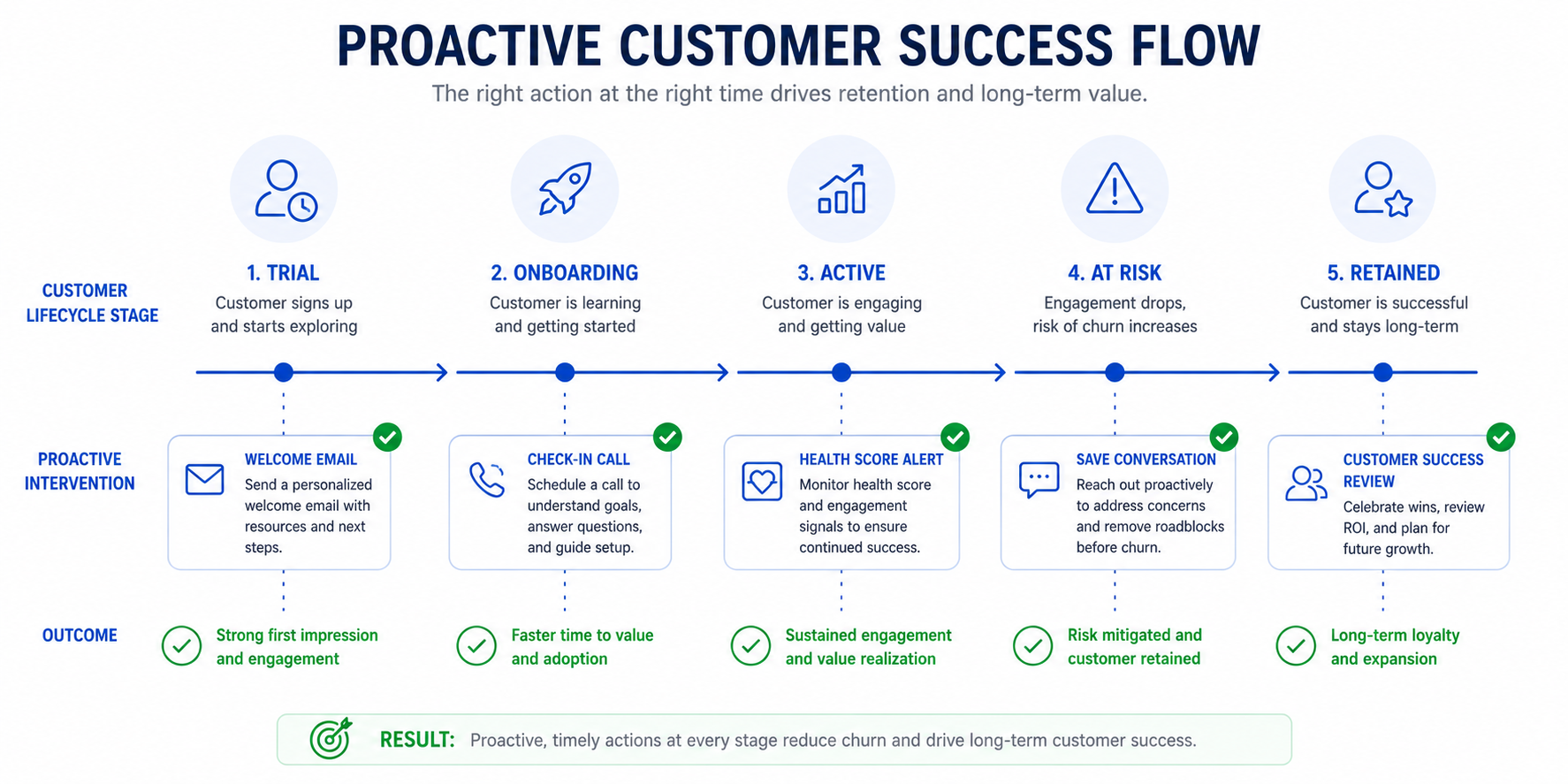
Proactive Customer Success
Don't wait for problems—anticipate them.
Health monitoring: Track at-risk accounts. Reach out before they cancel.
Regular check-ins: Quarterly business reviews for important accounts.
Success planning: Help customers define and achieve their goals with your product.
Expansion opportunities: Growing customers are less likely to churn. Help them expand usage.
Improve Support
Support interactions often determine whether a frustrated customer stays or leaves.
Speed matters: Faster response = better retention.
First contact resolution: Solve problems completely the first time.
Proactive communication: Update customers on issues before they ask.
Multiple channels: Meet customers where they are (chat, email, phone).
Self-service options: Documentation, videos, and community forums reduce friction.
Reduce Involuntary Churn
Tackle payment failures:
Dunning emails: Send reminders before and after failed payments.
Multiple payment methods: Don't rely on one card.
Card updater services: Automatically update expired card information.
Grace periods: Give customers time to fix issues before cancellation.
Retry logic: Retry failed payments at optimal times.
These changes alone can recover 20-30% of otherwise churned revenue.
Address Pricing Issues
Sometimes churn is about value vs. price.
Downgrade options: Offer lower tiers before cancellation.
Usage-based flexibility: Let customers scale down during slow periods.
Annual discounts: Annual plans have lower churn than monthly.
Pause options: Let customers pause instead of cancel.
Win-back offers: Targeted offers for about-to-churn accounts.
Build Switching Costs
Make leaving painful (in a good way):
Data and history: Value accumulated over time.
Integrations: Connections to other tools.
Team adoption: Multiple users trained and dependent.
Workflows: Customizations and automations built.
Network effects: Connections with other users/customers.
This isn't about locking people in—it's about delivering increasing value over time.
Measuring and Tracking
Key Metrics
Track these regularly:
- Gross churn rate: Percentage of customers lost
- Net churn rate: Accounts for expansion revenue (can be negative)
- Cohort retention: How different signup cohorts retain over time
- Time to churn: How long before customers typically leave
- Churn reasons: Why customers say they're leaving
Exit Surveys
When customers cancel, ask why:
- Multiple choice for quantitative data
- Optional free text for qualitative insight
- Keep it short (3-5 questions max)
- Act on what you learn
Sample questions:
- What's the main reason you're canceling?
- Is there anything we could have done differently?
- Would you consider returning in the future?
Cohort Analysis
Compare retention across customer groups:
- Signup month/year
- Acquisition channel
- Pricing tier
- Use case
- Company size
This reveals patterns. Maybe customers from paid ads churn faster. Maybe enterprise customers stick around longer.
Building a Retention Culture
Churn reduction isn't a one-time project—it's a company mindset.
Make retention everyone's responsibility: Not just customer success.
Tie compensation to retention: Align incentives.
Share churn data widely: Transparency drives action.
Celebrate retention wins: Not just new sales.
Invest in customer success: It's not a cost center—it's a growth driver.
Quick Wins to Start
If you're just beginning churn reduction:
-
Fix failed payments: Implement dunning. Quick wins.
-
Talk to churned customers: Learn why they left. Patterns emerge.
-
Identify at-risk accounts: Start with basic usage data. Act on it.
-
Improve onboarding: Focus on first-week experience.
-
Add a downgrade option: Give an alternative to cancellation.
Connecting the Dots
Reducing churn connects to your broader business strategy. A strong digital presence attracts quality customers who're more likely to stay. And customers who feel valued are more likely to refer others.
Retention compounds. The customers you keep today become the foundation for tomorrow's growth.
Building a SaaS product and need help with customer retention strategy? Contact Duo Dev for product consulting and development services.